The right choice depends on the space a gate occupies while moving, not on the motor name or purchase price. By measuring the entrance, checking the existing structure and defining safety and usage requirements, you can choose a system that fits the property and compare quotations on lifecycle cost.
Key takeaways
- Measure the full swing arc or the complete wall-side sliding run.
- Check slope, drainage, hinges, rollers and available structural support.
- Specify obstruction sensors, manual release and backup power with the motor.
- Give every installer the same dimensions, loads and operating requirements.
Start with the entrance geometry, not the gate motor
A swing layout fits only when each leaf has clear space through its entire opening arc, inside or outside the boundary. A sliding layout fits only when a straight wall-side run can hold the complete leaf, not just the advertised clear opening. Measure the geometry in Wardha before choosing a motorized swing gate for Wardha.
Record these measurements on site:
- Clear opening width between finished posts
- Each gate leaf width and height
- Swing arc clearance from walls, parked vehicles, drains and pedestrian paths
- Straight side-run length for the sliding leaf, including end stops, guide posts, rollers, rack and manual-release access
- Driveway slope, crossfall and finished-ground level
- Space for the motor, control box, battery and cable route
| Option | Geometry and installation check | Consequence |
|---|---|---|
| Swing | Needs an unobstructed arc and strong hinges; check whether leaves open inward without blocking the driveway | Uses less side-run but loses usable space in the sweep and demands hinge-side foundations |
| Sliding | Needs a level, rigid travel path and side clearance longer than the opening; a cantilever leaf shifts load to posts and footing | Preserves the driveway opening but requires track drainage or heavier civil work |
| Swing | Leaves can open quickly with lighter civil alteration when posts already align | Wind on tall solid leaves increases torque and hinge wear |
| Sliding | Mud, stones and monsoon debris can jam a bottom track | Cleaning access and drainage become part of the design |
Do not size the operator from gate width alone. Leaf mass, length, hinge friction, slope, wind exposure and expected cycles determine the load; a motorized sliding gate Wardha installation also needs room to release and move manually during power failure.
Compare the real space, civil work and operating trade-offs
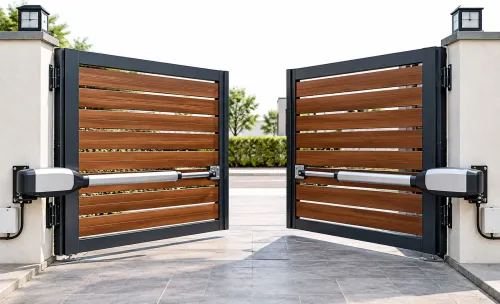
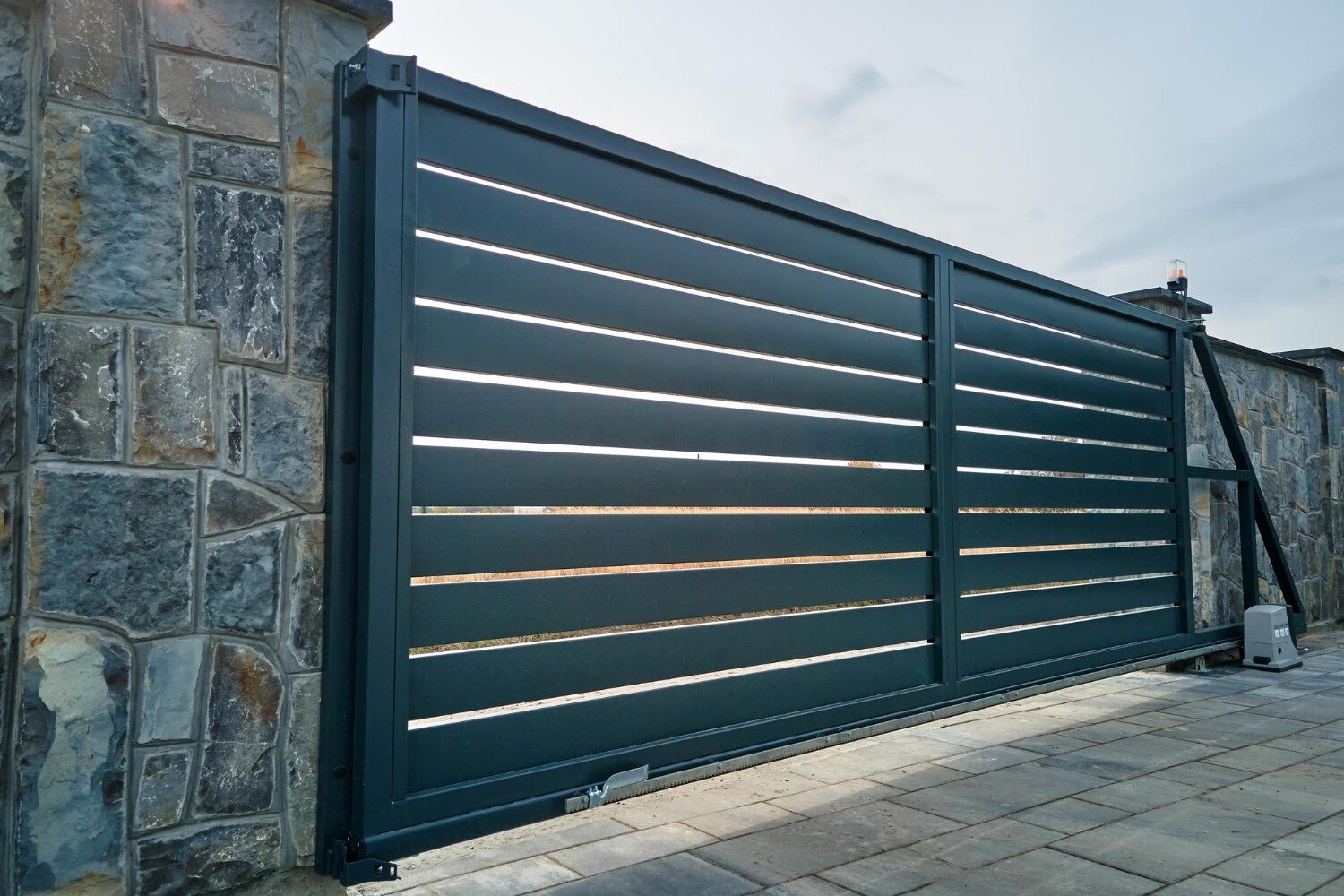
A swing gate usually needs less civil work and opens without a side run-back, but its leaves occupy the driveway’s swept arc. A sliding gate keeps that arc clear and preserves the full opening width for vehicles, yet it needs a straight wall-side zone longer than the opening itself.
The better balance depends on which space your property has in surplus.
| Option | Usable driveway and opening speed | Structural load | Installation effort |
|---|---|---|---|
| Swing gate | Full width is usable when open, but parked vehicles and pedestrians need arc clearance. Two-leaf systems can open quickly. | Hinges and operators carry leaf weight, wind torque and slope forces. Tall solid leaves increase torque sharply. | Usually simpler foundations and fewer civil alterations, provided the posts are sound. |
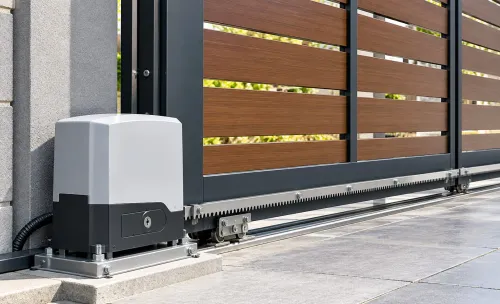
| Sliding gate | Keeps the driveway clear, but the leaf, rollers, end stops, rack and motor need a complete side run. It can take longer because the leaf travels its full width. | Ground-track systems spread load through rollers; cantilever systems transfer higher bending loads into posts and footings. | Requires a level rigid path, drainage and access for cleaning or roller replacement. |
Before choosing a motorized sliding gate Wardha installation, measure these points:
- Clear opening width and the full leaf length, including counterbalance or overlap.
- Straight side-run length, guide-post space, end-stop clearance and manual-release access.
- Finished-ground level, driveway slope, drainage route and any low spots that collect monsoon debris.
- Swing clearance from walls, vehicles, pedestrian paths and the opposite leaf.
- Foundation space for posts, hinges, rollers, motor, rack, controls and safety devices.
A swing layout is the practical choice when side-run is unavailable. Choose sliding when a straight wall-side run exists and uninterrupted driveway width matters more than minimum civil work.
Inspect the ground, gate structure and maintenance conditions
Before automation, the gate must move smoothly by hand, stand square in its opening and stop against solid mechanical limits. Loose hinges, a twisted frame, failing rollers or a binding leaf will overload the operator; a motor amplifies the defect rather than correcting it.
1. Measure the clear opening, each leaf’s width and mass, the full swing arc, driveway slope, finished-ground level and space for the motor, control box and battery. Check the arc against parked vehicles, walls, pedestrian paths and the opposite leaf.
2. For a sliding gate, measure a straight side run at least long enough for the complete leaf, end stops, guide posts, rollers, rack, motor and manual-release access. Keep the travel path level and rigid; a bottom track needs drainage and regular removal of mud, stones and monsoon debris.
3. Inspect hinges, posts, welds, rollers, guide brackets and foundations for movement, cracks, corrosion or distortion. Repair them before selecting an operator, and provide positive stops at both ends so the gearbox never absorbs the gate’s stopping force.
4. Confirm that the footing, track base or cantilever posts suit the gate’s load. A cantilever avoids a driveway track but transfers greater bending load into its posts and foundation.
5. Record wind exposure, solid or grille construction, expected opening cycles, power quality and maintenance access. These details matter more than a nominal motor weight rating for swing gate automation in Wardha, and they reveal whether the existing gate is worth automating.
Specify the motor, safety system and emergency operation together
Choose the drive from measured resistance, not the gate’s weight alone. Specify a motor rated for the gate’s leaf length, mass, slope, wind exposure and expected cycles per hour, with a duty rating that matches residential, commercial or industrial use.
A sliding gate also needs a rigid, level travel path, drainage and protection from monsoon mud and stones; a swing operator needs sound hinges and a frame that moves freely by hand.
Require the quotation to state:
- Motor capacity, duty cycle, maximum leaf length and maximum gate mass
- Positive mechanical stops at both travel ends, with limits or an encoder stopping the drive before those stops
- Photocells across the opening, monitored safety inputs and force limitation that stops or reverses movement before harmful contact
- Safety-edge sensors where a moving leaf can trap a person, with emergency-stop behaviour and automatic-restart prevention documented to ISO 13849-1
- A controller that accepts a volt-free open command while keeping photocells, edges and emergency stop hardwired or supervised; a GSM relay, access reader or building-management system must not bypass them
Test every safety device with the gate closing, including broken photocell wiring and power restoration. A gate that reverses only after striking an obstacle is unsafe.
Provide a mechanical manual release for mains or controller failure. Keep its key or procedure with authorised staff, and place the release outside the moving path. Battery backup helps during short outages but does not replace that release. Clearance, alignment and hand-force checks must pass before commissioning.
Turn the choice into a comparable installation brief
Require an itemised quotation and a witnessed commissioning record; a single lump-sum price hides whether the installer has allowed for civil work, safety devices, drainage and future servicing. Ask Nagpur Automation (08048400505), or any competing installer, to price the same written brief.
- State the measured opening width, leaf dimensions, swing clearances or sliding side-run, slope, finished ground level, motor position and control-box position. Require a drawing showing posts, rollers, rack, end stops and cable routes.
- Separate gate fabrication, hinges or rollers, foundations, conduits, power supply, motor, photocells, pressure-sensitive edges, warning lamp, access controls, battery and painting. Name the operator’s duty rating, maximum gate mass, speed, ingress-protection rating, warranty and response arrangement.
- Require the installer to state every safety point covered: vehicle-opening photocells, hinge and closing gaps, rack-and-pinion zones, emergency stop, monitored inputs, force limitation and restart behaviour. Ask for the applicable ISO 13849-1 performance level.
- During commissioning, move the gate by hand before connecting power; reject binding, loose hinges, distorted frames or failing rollers. Test obstruction detection without hard contact, photocell interruption from both directions, power-failure behaviour and controlled manual release.
- Witness repeated full cycles, confirm positive mechanical stops at both ends, verify the motor stops before those stops, inspect sealed cable glands and drainage, and receive keys, release instructions, wiring diagrams and maintenance intervals.
Do not approve completion because the gate opens once. Keep the signed test sheet, as-built measurements and fault contacts with the property records; they make competing quotations and later repairs comparable.
Related products
 | MOTORIZED SLIDING GATE Motorized Sliding Folding Gate Motorized Sliding Folding Gates are useful where there is restricted and compact space for entrace. View product → |
 | Automatic Motorized Swing Gate Our company has emerged as one of the top most positions in the industry for offering a wide range of Automatic Motorized Swing Gate. View product → |
Frequently asked questions
When does a motorized swing gate suit a Wardha property entrance?
Choose a swing layout when each leaf has unobstructed space through its full opening arc, inside or outside the boundary.
When does a motorized sliding gate suit a Wardha property entrance?
Choose a sliding layout when a straight wall-side run can store the complete gate leaf beyond the clear opening.
What should you inspect before selecting the gate motor?
Inspect the ground slope, drainage, hinges, rollers, gate weight, structural posts and maintenance access before specifying the motor.
What should an installation brief include?
Include opening dimensions, gate weight, operating cycles, power supply, safety sensors, manual release, backup power and civil-work requirements.
Related products
 | We are offering a wide range of Swing Gate Automation. an aesthetic match for any architectural style. View product → |
 | We are highly acknowledged organization engaged in presenting remarkable range of Automatic Swing Gate. View product → |
 | Automatic Electric Sliding Gate Our company is highly esteemed in providing Automatic Electric Sliding Gate. View product → |
 | Leveraging over the skills of our qualified team of professionals, we are instrumental in offering Automatic Sliding Gate. View product → |
Keywords