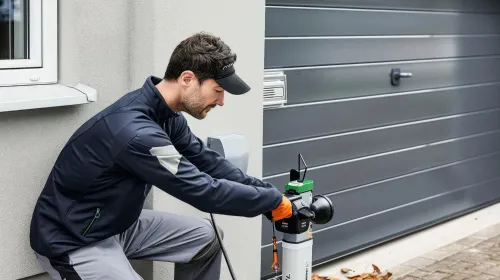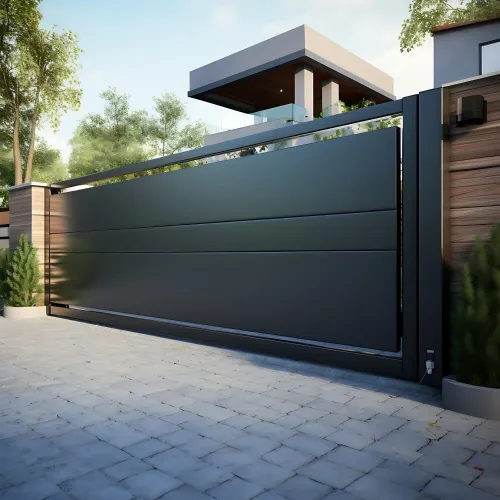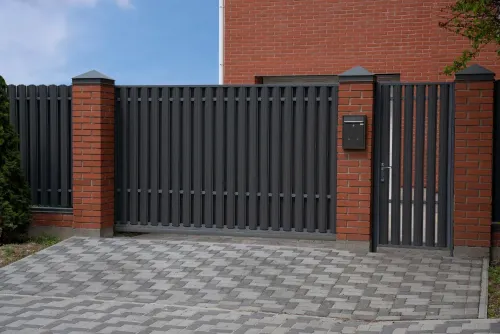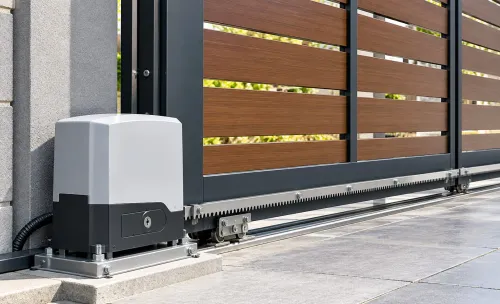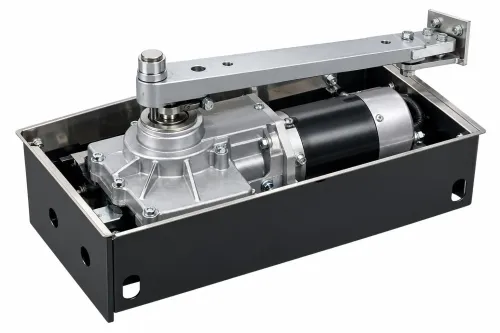
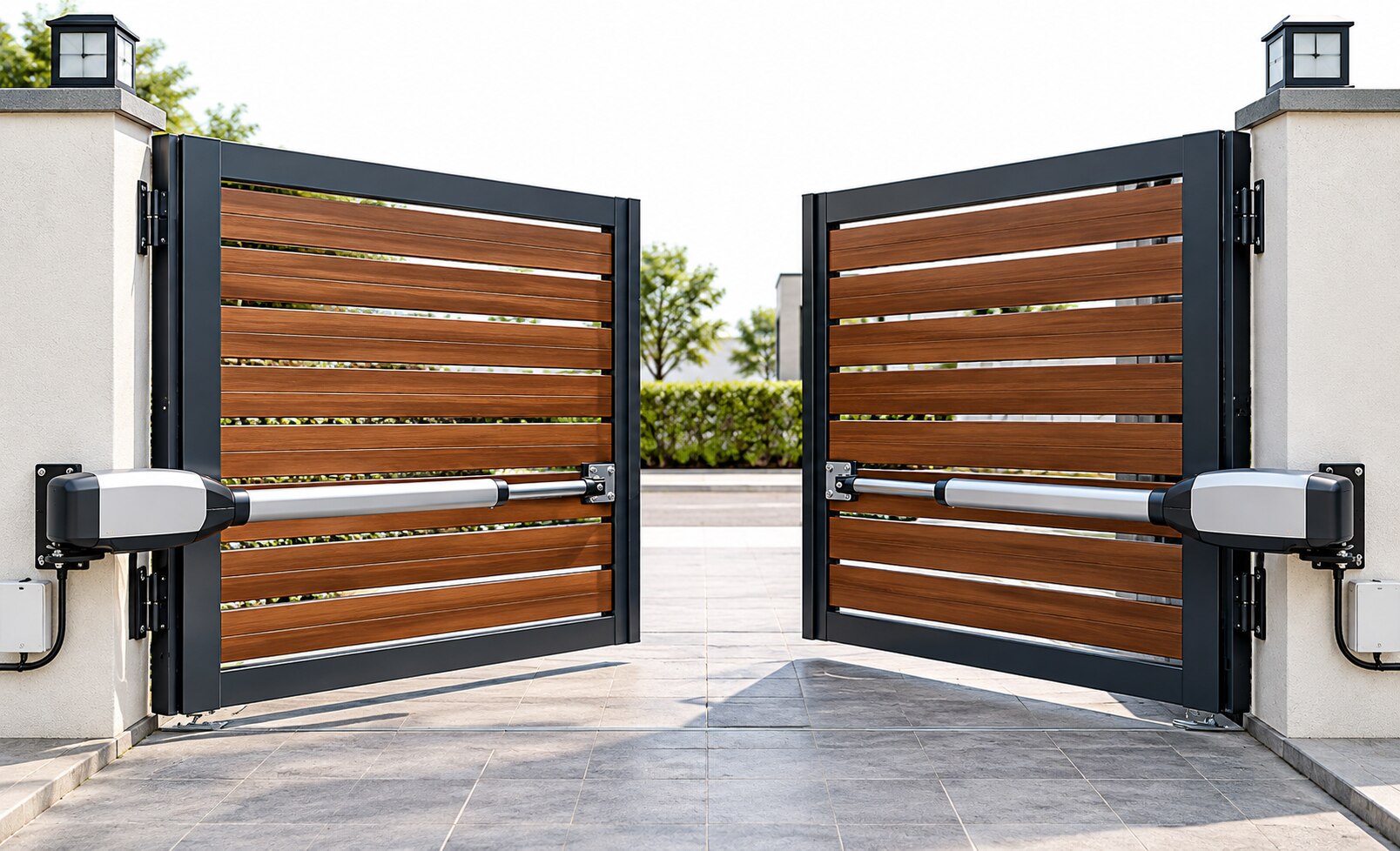
A motorized gate will not solve a sagging leaf, weak pillar, narrow vehicle approach or unsafe opening arc. You will be able to assess your site, choose the correct single- or double-leaf arrangement, prepare the electrical supply and verify the installation before relying on it every day.
Key takeaways
- Measure leaf sweep and road setback, not just the clear opening.
- Repair sagging hinges, weak posts and uneven stops before fitting motors.
- Choose folding leaves when a standard swing arc blocks vehicles or pedestrians.
- Test obstruction reversal, manual release and power-failure operation before acceptance.
Does your Pune property have enough space for a swing gate?
A motorized swing gate for Pune residential use fits only when the clear vehicle opening, leaf sweep and road setback work together; the plot opening alone proves nothing. Hinges, posts, stops and the leaves’ arc reduce the usable width.
1. Measure the clear vehicle opening between the finished hinge-side obstructions, not between plot boundaries. Record each leaf’s width and mass, hinge-to-wall distance, required opening angle, and setback from the road edge. Note whether the gate swings inward, outward or both during release.
2. Mark the complete swept area on a site plan. Include the compound wall, parked vehicles, landscaping, pedestrian route, public footpath, drainage and every sloped or uneven section of driveway. A 90-degree opening can still strike a wall, vehicle or person when programmed wider.
3. Inspect wind exposure before choosing the operator. A wide solid leaf can impose greater wind load than an open-bar leaf of the same mass. Select the operator from leaf width, mass, hinge friction, opening angle, wind exposure and duty cycle—not weight alone.
4. Complete this motorized swing gate Pune checklist: clear opening; leaf-to-wall distance; vehicle turning path; pedestrian route; drainage level; and positive mechanical stops at the fully open and fully closed positions. The stops must be physical; an actuator limit switch alone passes impact into its gearbox and brackets.
The final clear opening will be smaller after hinges, posts and stops are counted. If the sweep crosses a public footpath or road edge, change the gate geometry before ordering automation.
Should you install one leaf, two leaves or a folding arrangement?
A single leaf suits an entrance when its width, mass, hinge condition and wind load remain within one actuator’s rated limits. It has fewer moving parts, but its larger side sweep needs clearance from walls, vehicles and pedestrian routes.
| Option | Main advantage | Main requirement |
|---|---|---|
| Single leaf | Fewer actuators, wires and moving parts | One suitably rated actuator and a clear full-length sweep |
| Two leaves | Smaller sweep for each leaf | Two synchronised actuators, sequencing and accurate alignment |
| Folding leaves | Shorter sweep near the hinge side | Intermediate hinges, coordinated folding and extra clearance |
A two-leaf gate normally needs two synchronised actuators. Set a lead leaf and trailing leaf for closing, provide a firm central stop or overlap, and adjust speeds so the leaves cannot collide when their travel or limit settings differ. The smaller sweep does not remove the need to check the complete arc.
Motorized swing folding gate details require separate checking. Each folding panel needs correctly placed intermediate hinges, a controlled fold path and room for folded panels, operator arms, posts and walls. Mark pinch points both when the panels are fully open and when they are folded; fingers, vehicles and clothing can enter those gaps.
For an automatic swing gate for homes, protect the closing path with photocells or presence detection and include obstacle detection and manual release. Programming a 90-degree opening is not enough if the site could later use a wider angle.
Recheck the wider path before changing settings, or a safe opening can become a trapping or collision point.
What must be repaired before the automation is mounted?
Repair the gate before choosing brackets or calculating actuator loads. An actuator cannot straighten a sagging leaf, strengthen an undersized hinge plate, fix weak anchorage or level an uneven driveway. Those faults cause slow travel, limit-switch errors and premature gearbox wear.
1. Close and open each leaf by hand through its full travel. Binding, scraping or a leaf that needs lifting indicates hinge, frame, stop or driveway problems that require repair.
2. Measure whether the top corners stay level while each leaf moves. Inspect hinge pins and plates for play, then examine welds for separation and steel for corrosion. Replace loose hardware and repair cracked welds.
3. Push and pull at each free edge. The gate frame and hinge pillars must remain stiff; movement points to a flexible frame, undersized plates or poor anchorage. Check masonry posts for cracks, leaning, hollow patches or movement at their bases.
4. Before a motorized swing gate Pune installation, clear drains, remove monsoon mud around hinges and prevent waterlogging at each post base. Remove dust from moving joints and coat exposed steel against corrosion.
5. Specify a weather-resistant control enclosure, sealed cable glands and drip loops on exposed wiring. An outdoor-rated motor does not make junction boxes or cable joints weatherproof. Reinforce posts and correct alignment first; select brackets only after the gate moves freely and remains rigid.
How should the gate, power supply and safety system be installed?
1. Confirm the clear opening, leaf width and mass, hinge-to-wall clearance, swing arc, driveway level and required opening angle. Include the vehicle route, pedestrian path, road edge and parked vehicles.
2. Reinforce masonry posts and gate frames before selecting brackets. A weak post transfers actuator force into cracks and misalignment.
3. Fit sound hinges or repair them first. Each leaf must move freely by hand without sagging, binding or excessive play.
4. Mount the actuator brackets at the manufacturer’s specified geometry, then install positive mechanical stops for both open and closed positions.
5. Prepare an electrical plan identifying the supply point, cable route, protective conduit, weather-resistant junction boxes, sealed cable glands, drip loops, earthing connection and a nearby isolator for safe servicing. Monsoon exposure makes an outdoor-rated motor insufficient protection for cable joints or the controller.
6. Route the protected conduit, fit the control panel, connect the isolator and earthing, and verify supply protection before energising the system.
7. Size battery backup for the required number of outage cycles using motor current, battery voltage, gate mass, friction, opening frequency and standby consumption. The word “battery” alone proves nothing.
8. Set travel limits and programme the single- or double-leaf sequence, including the lead leaf, trailing leaf and central stop where two actuators are used. Pair remotes only after these settings work.
9. Install photocells or presence detection across the closing path and enable obstacle detection. Sensor failure must inhibit powered closing and show a fault until corrected.
10. Use EN 12453 as a design reference for crushing, shearing, impact and trapping hazards; confirm the edition and national adoption for the project. A remote control is not a safety system.
What should you test before accepting the installation?
A remote opening test proves almost nothing about safety. Commission the motorized swing gate Pune installation with the gate fully loaded, then record each result rather than accepting “automatic” as proof of correct adjustment.
1. Close the gate repeatedly and interrupt the photocell beam. Confirm that the leaves stop or reverse, obstacle detection responds to resistance, and the system has a defined response if a sensor fails.
2. Check both mechanical end stops at fully open and fully closed positions. Confirm that neither leaf strikes a wall, stop, vehicle or pedestrian route.
3. Run several closing cycles and verify the lead and trailing leaves keep their programmed sequence without colliding or leaving a dangerous gap. Test an automatic swing gate for homes with its normal remotes and controls.
4. Isolate the mains and disconnect the battery. Demonstrate the manual release, then make the resident operate it. Keep the release key accessible but secure, and place the release point outside the gate’s swept area. After release, ensure the gate cannot drift into the road or remain unsecured.
5. Operate the gate through several mains-failure cycles and record the battery performance against the expected cycle count. Recheck photocell alignment after paving, pillar finishing and final gate adjustment; settlement or a shifted bracket can remove the detection zone.
Require a handover record listing remotes, isolator location, battery-cycle expectation, release instructions, hinge-cleaning guidance and service contacts. Nagpur Automation (08048400505) is one installer to ask for this measured commissioning checklist, Pune coverage and post-installation test record before appointment.
Related products
 | We are highly acknowledged organization engaged in presenting remarkable range of Automatic Swing Gate. View product → |
 | We are offering a wide range of Swing Gate Automation. an aesthetic match for any architectural style. View product → |
Frequently asked questions
Does a Pune property have enough space for a motorized swing gate?
Measure the clear vehicle opening, each leaf’s sweep, hinge positions, gate stops and the road setback. The gate needs its full opening arc without striking vehicles, walls, pedestrians or the road.
Should you install one leaf, two leaves or a folding arrangement?
Use one leaf for a narrow opening when the post and hinge can carry its weight. Use two leaves for wider openings with balanced loads. Choose folding leaves when the driveway cannot provide the normal swing depth.
What must be repaired before the automation is mounted?
Repair loose or undersized posts, sagging leaves, worn hinges, bent frames, uneven paving and missing end stops. The gate must move smoothly by hand before a motor is installed.
How should the gate, power supply and safety system be installed?
Mount the operator on rigid supports, protect cables in suitable conduit, provide the specified electrical isolation and fit photocells, warning lights, limit controls and a manual release. Keep moving joints and cables protected from pinch points.
What should you test before accepting the installation?
Test full opening and closing, stopping at limits, obstruction reversal, photocell detection, manual release and operation during power failure. Check that the leaves do not scrape, bounce or leave unsafe gaps.
Related products
 | Automatic Motorized Swing Gate Our company has emerged as one of the top most positions in the industry for offering a wide range of Automatic Motorized Swing Gate. View product → |
 | We hold expertise in offering a superior range of Swing Gate Opener, which is commonly used in offices, apartments and corporate houses. View product → |
 | MOTORIZED SWING GATE MOTORIZED SWING FOLDING GATE View product → |
 | MOTORIZED SWING GATE MOTORIZED SWING GATE View product → |
Keywords