
A stalled hospital gate can obstruct an ambulance lane, trap vehicles inside, or leave a controlled entrance unsecured. You will be able to isolate the fault safely, restore movement without bypassing protection, and identify when the gate needs structural or installation correction rather than another reset.
Key takeaways
- Isolate power and disable every automatic start signal before inspection.
- Check tracks, rollers, cantilever wheels, stops, and gate alignment for movement faults.
- Separate motor, control, sensor, and mechanical failures before replacing parts.
- Test emergency release, fire-alarm input, access readers, and obstruction protection before reopening.
How to make the gate and emergency routes safe before inspection
1. Stop automatic operation before anyone approaches the gate. Isolate electrical power at the operator’s disconnect or locked distribution point, then use the manufacturer’s manual-release mechanism. Confirm that a remote, card reader, intercom, loop detector, fire-alarm relay, or building-management input cannot start the gate.
2. Secure the leaf fully open, or in another approved safe position, with a physical restraint. Do not trust the motor brake. Keep staff, patients, visitors, and vehicles outside the travel path, including the fire lane, emergency exit, ambulance turning area, and pedestrian route.
3. Assign a trained marshal to the ambulance entrance and divert vehicles through a documented secondary route. Use a protected wicket door or barrier-free pedestrian opening; never send pedestrians through the vehicle opening. Record the outage time, gate position, person in charge, and temporary access arrangement.
4. After manual release, move the leaf by hand through its complete travel. If it binds, scrapes, drops, or will not move freely, stop: the fault is mechanical, such as a seized roller, obstruction, bent track, or failed bearing. Replacing the motor or resetting the controller is unsafe.
5. Treat this isolation procedure as the first step in any attempt to restore motorized sliding gate for movement hospitals in Nagpur. A hospital gate automation plan must keep emergency access and pedestrian protection operating while the gate is inspected.
How to separate electrical, control, sensor, and movement faults
The symptom usually identifies the fault family: a dead operator suggests electrical failure, a clean stop at the wrong position suggests limits or control, and a binding leaf suggests mechanical drag. Before opening the control cabinet, check the breaker, isolator, fuses, supply voltage, and voltage under motor load.
1. Record the controller fault code before clearing it. Check the motor overload indication, encoder, limit switches, and open and close limit settings. A tripped breaker or dead supply requires electrical investigation; repeated breaker trips require a qualified electrician.
2. Release the operator and move the leaf by hand through its full travel. If it binds, inspect for a seized bearing, bent rail, excessive gate weight, poor rack-to-pinion mesh, loose mounting, or insufficient torque. A motor that hums, slows, overheats, or trips while the leaf binds confirms drag rather than a simple reset fault.
3. Treat a clean, consistent stop at the wrong position as a limit, encoder, or control-setting fault. Repeated starts, unexplained opening, or failure to close can come from a stuck relay, card reader, intercom, remote receiver, fire-alarm interface, building-management input, or loop detector.
Read the controller’s live input-state display and review relay logic instead of guessing.
4. Clean and align the photo-eyes, inspect cables and condensation, and test the safety edge. Dirt, direct sunlight, or misalignment can interrupt the beam, but a photo-eye does not replace monitored obstruction protection or measured closing-force and reversal testing.
This sequence separates hospital gate automation faults from common sliding gate movement problems before parts are replaced.
How to inspect ground-track and cantilever gate mechanisms
The gate design determines the mechanical checks. Compare the two mechanisms before adjusting the motor or controller.
| Gate design | Inspect | Failure that requires repair |
|---|---|---|
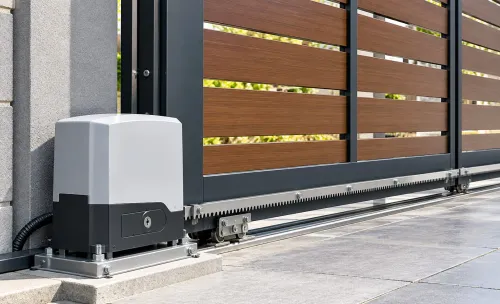
| Ground-track | Remove stones, mud, standing water, cable ties, and debris; check rail straightness, level, joints, wheel loading, guide rollers, end stops, anti-lift devices, rack alignment, pinion engagement, and loose operator fixings | A lifted, sunken, shifted, cracked, or water-damaged foundation needs civil repair; cleaning will not restore reliable travel |
| Cantilever | Inspect both roller carriages, foundation plates, cantilever beam, welds, guide frame, receiver post, end stops, and anti-lift retainers | Sag, twisting, abnormal deflection, ground contact, or structural looseness requires assessment before operation |
For a ground-track gate, move the released leaf by hand and confirm smooth travel through its full opening. A seized wheel, bent rail, excessive wheel loading, or poor rack-and-pinion mesh will increase drive torque and trigger overloads.
For a cantilever sliding gate hospital entrance, check clearance beneath the suspended leaf and inspect the carriage foundations for movement. This design suits an unobstructed ambulance lane or poor drainage, but the full leaf load transfers into the carriages and foundation. Excessive movement can disengage the rack and pinion.
Do not operate a visibly sagging or loose leaf. Have the gate fabricator or a structural engineer assess the beam, welds, carriage plates, and foundation before restoring a motorized sliding gate in Nagpur.
How to restore movement and recommission hospital access controls
After the physical fault is corrected, recommission the hospital gate automation as a complete access system, not as a motor that merely moves once.
1. Clear the travel path of stones, mud, standing water, cable ties, and other debris. Repair or align the rail, rollers, rack, pinion, chain, bearing, or carriage, then tighten the operator mounting. Check the gate is plumb, wheel loading is even, and manual travel is smooth through the full opening.
2. Measure supply voltage while the motor runs. Set the open and closed limits, and confirm the leaf stops before the end stops. Test photo-eyes, monitored safety edges, emergency stop, manual release, and obstruction reversal.
3. Run repeated open-close cycles with no traffic, then repeat them during normal ambulance, staff, visitor, and service-vehicle movements. Test loop detectors separately from pedestrian protection: a vehicle loop does not reliably detect a person, wheelchair, bicycle, or small object. Keep the pedestrian route barrier-free.
4. Test RFID or card readers, intercoms, remote controls, access logs, fire-alarm relay behaviour, and every building-management-system command. Confirm the documented response to mains failure, controller failure, fire alarm, and exhausted battery: the gate must open, remain open, or stay secured under the hospital’s fire and security strategy.
Record test results, fault codes, settings, and the person who accepted the motorized sliding gate in Nagpur back into service.
How to prevent a repeat failure and choose the right repair support
Restored movement is only temporary when lubrication, a reset, or a limit adjustment makes the leaf move without removing the cause. A bent track, cracked foundation, overloaded leaf, undersized operator, poor drainage, loose rack, or worn cantilever carriage will return as a stoppage, overload, or safety risk.
| Intervention | What it can correct | What it cannot repair |
|---|---|---|
| Lubrication or cleaning | Surface friction and minor debris | Bent rail, seized bearing, poor drainage, or structural damage |
| Controller reset or limit adjustment | A recorded control or travel-setting fault | Mechanical binding, excessive closing force, or an overloaded leaf |
| Battery backup or UPS | Controlled access during a mains outage | A gate that binds mechanically or has failed bearings |
Compare the operator’s duty rating with real hospital traffic, including shift changes, ambulance demand, staff vehicles, visitors, and service vehicles. Static gate weight alone is insufficient; repeated thermal trips indicate an operating-cycle mismatch or excessive resistance.
Size the backup from leaf mass, travel distance, cycle count, acceleration, and required standby time. Keep the manual release usable after the battery is exhausted. For a motorized sliding gate in Nagpur, ask for the enclosure IP rating under IEC 60529 and protection details for dust, rain, wash-down water, cable glands, and heat.
- Written fault report and measured manual-travel result
- Controller input record and safety-test results
- Recommended structural repairs and completed commissioning
For a cantilever sliding gate hospital entrance, Nagpur Automation can assess mechanics, operator duty, safety devices, and access-control integration together. Choose support that documents the repair, not merely makes the leaf move once.
Related products
 | MOTORIZED SLIDING GATE Motorized Sliding Folding Gate Motorized Sliding Folding Gates are useful where there is restricted and compact space for entrace. View product → |
 | Motorized Telescopic Gate Automatic Telescopic Sliding Gate With the support of our professionals, we are involved in offering best quality of Automatic Telescopic Sliding Gate. View product → |
Frequently asked questions
How do you make hospital emergency routes safe before inspecting a sliding gate?
Stop automatic operation, isolate power at the operator disconnect or locked distribution point, engage the manual release, and prevent remotes, readers, intercoms, loop detectors, fire-alarm relays, and building-management inputs from starting the gate. Keep an alternative emergency route open and control vehicle and pedestrian movement during the inspection.
How can you separate electrical, control, sensor, and movement faults?
Check whether the operator receives power, whether the controller shows a fault code, and whether command devices issue a start signal. Then inspect photocells, safety edges, loop detectors, and fire-alarm inputs. If the motor runs but the gate does not travel, inspect the drive coupling, rack, rollers, wheels, track, and mechanical stops.
What should you inspect on a ground-track or cantilever sliding gate?
For a ground-track gate, clear debris and inspect the rail, guide rollers, gate wheels, bearings, rack, pinion, end stops, and alignment. For a cantilever sliding gate, inspect the support frame, carriage rollers, receiver posts, guide rollers, counterbalance alignment, rack, pinion, and travel clearance.
How do you recommission hospital gate automation after restoring movement?
Restore power only after the travel path is clear. Set limits, test manual release, verify opening and closing direction, check photocells and obstruction protection, test access-control commands, and confirm the fire-alarm release or fail-safe function. Record test results and keep an emergency access procedure at the gate.
How can hospitals prevent repeat sliding gate movement failures?
Schedule cleaning and inspection of tracks or cantilever carriages, lubricate only manufacturer-approved points, keep vegetation and parked vehicles outside the travel zone, test safety devices, and record recurring fault codes. Use repair support that can inspect mechanical hardware, automation controls, access devices, and emergency interfaces together.
Related products
 | Automatic Electric Sliding Gate Our company is highly esteemed in providing Automatic Electric Sliding Gate. View product → |
 | Leveraging over the skills of our qualified team of professionals, we are instrumental in offering Automatic Sliding Gate. View product → |
 | We hold expertise in offering a superior range of Sliding Gate Automation, which is commonly used in offices, apartments and corporate houses. View product → |
 | MOTORIZED SLIDING GATE MOTORIZED INDUSTRIAL GATE View product → |
Keywords