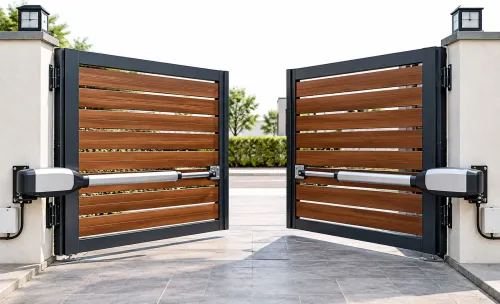
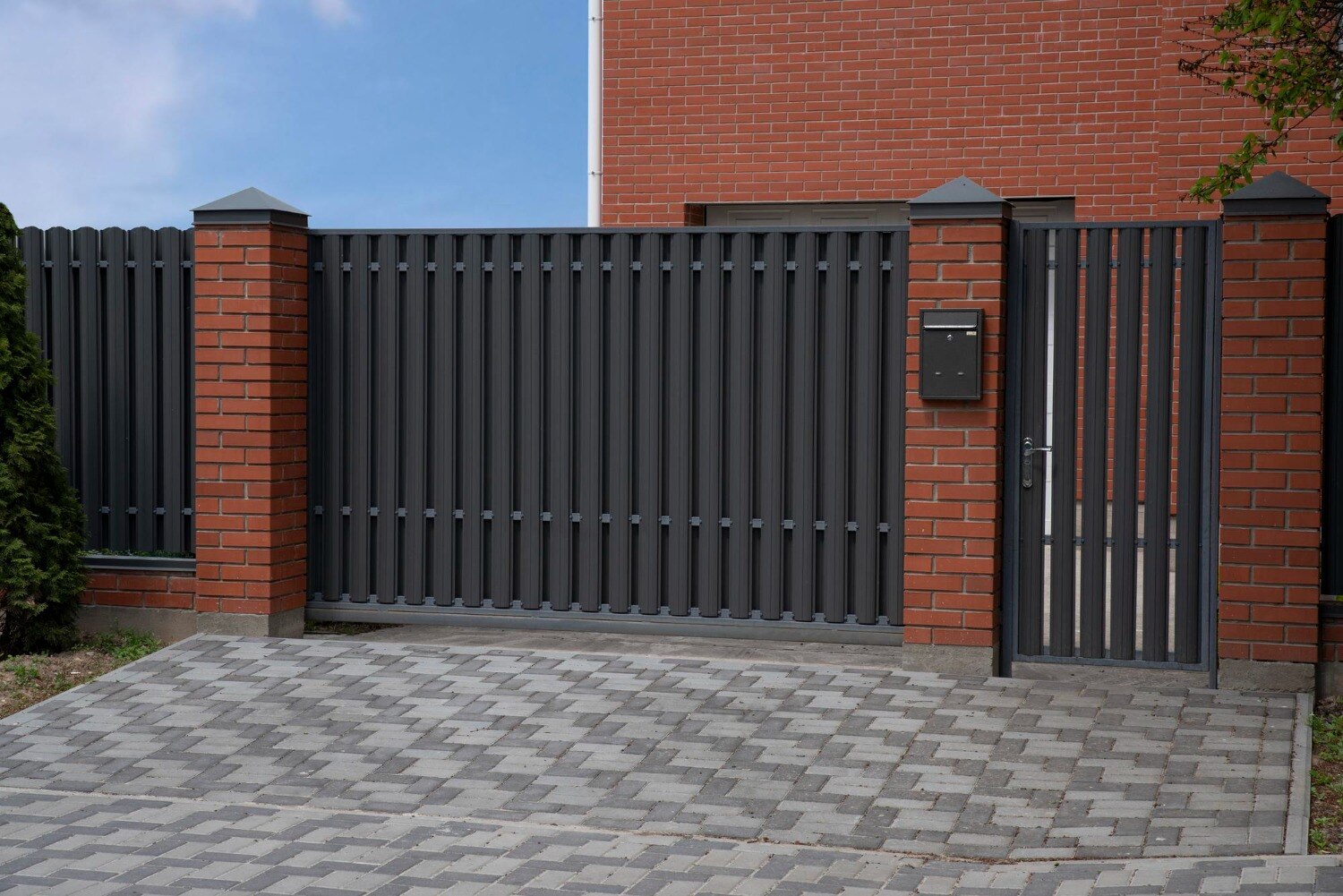
A fast industrial entrance depends less on the motor’s advertised speed than on correct side-run space, foundations, drainage, power, safety controls and commissioning. By the end, you can check whether a cantilever design suits your Raipur site, compare alternatives, prepare a complete tender brief and assess a supplier’s installation readiness.
Key takeaways
- Keep the gate tail clear; it needs space behind the opening.
- Measure opening width, tail space, ground levels and vehicle turning radius.
- Choose tracked, telescopic or swing gates when site constraints rule out cantilevering.
- Demand installation tests for travel, safety sensors, obstruction response and manual release.
How a cantilever gate keeps the driveway clear for trucks
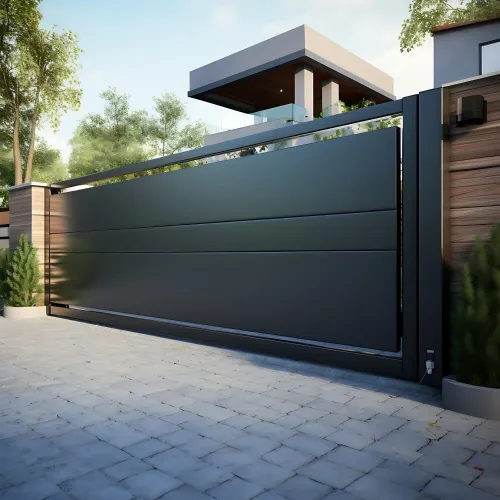
A motorized cantilever gate slides sideways without a wheel running on a road track. Its gate leaf hangs from a bottom guide beam, while foundation-mounted roller carriages carry the load at one side. A counterbalanced tail extends behind the opening, keeping the leaf stable as the operator moves it.
This mechanism suits busy industrial entrances for three practical reasons:
- There is no ground rail for mud, gravel or truck tyres to block, so cleaning and repairs are easier.
- The driveway remains flush and clear, reducing a trip point for trucks and leaving no rail to damage during turning.
- The gate can operate over uneven pavement where a tracked slider would bind or collect debris.
The space saving has a condition: the gate needs a clear side-run beyond the opening for its tail. That tail is often about 30–40% of the clear opening, but the final length depends on gate mass, frame stiffness, infill and wind load.
A solid leaf can overload carriage bearings even when the motor’s weight rating looks sufficient.
Specify duty in cycles per hour and cycles per day, not just “heavy duty.” Shift-change traffic needs different thermal capacity and maintenance intervals from a gate opened a few times daily.
For an industrial cantilever gate in Raipur, include dust, monsoon drainage, lightning and voltage variation in the design. Protect the photocells, junction boxes and cable joints—not only the motor enclosure.
Measure the Raipur entrance before choosing the gate
Record the finished clear opening, not the gap between unfinished pillars. A motorized cantilever gate also needs a counterbalanced tail beyond the opening, commonly 30–40% of the clear opening; the supplier must calculate the actual length from gate mass, infill and wind load. Measure the entrance and inspect these points:
- Measure opening width, gate height, available headroom and the full side-run on the sliding side. Include space for the motor, manual-release handle and control cabinet.
- Mark the boundary line, nearby walls, columns, fire equipment and vehicle turning path. A long truck must clear the gate without striking the tail or waiting across the public road.
- Check the road slope and finished levels. A steep crossfall, standing water or a drain crossing the carriage foundation can delay installation or distort the frame.
- Locate sound ground for reinforced-concrete carriage and guide-post foundations. Record soft fill, buried services, rock, tree roots and the position of existing drains before excavation.
- Specify gate mass, infill percentage and wind exposure separately from motor capacity. A solid leaf can overload bearings or rack in strong wind even when the operator’s weight rating is sufficient.
- Plan conduits above flood level and protect photocells, junction boxes and cable joints from dust, monsoon water, lightning and voltage variation.
| Check | Measure or inspect | Fit consequence |
|---|---|---|
| Clear opening | Pillar-to-pillar finished width | Sets the passage size and counterbalance length |
| Side-run | Unobstructed length behind one pillar | Insufficient space rules out the layout |
| Foundation zone | Soil, drains, services and levels | Determines civil work and carriage position |
| Road and queue | Slope, turning radius and waiting space | Prevents vehicle conflict during opening |
Compare cantilever, tracked, telescopic and swing gates
Choose the layout by matching available space, ground condition, traffic pattern and duty cycle—not by selecting the fastest motor. A cantilever gate suits entrances where the roadway must remain clear and the ground is uneven, but its carriage foundation and counterbalance need adequate side-run.
| Option | Main advantage | Choose it when | Main drawback |
|---|---|---|---|
| Cantilever sliding | No rail across the roadway; tolerates debris and minor level changes | Trucks cross frequently, drainage is poor, or the road must stay unobstructed | Needs side-run for the leaf and counterbalance, plus reinforced foundations |
| Tracked sliding | Compact side-run and strong support from a ground rail | The entrance has firm, level paving and regular cleaning | Mud, stones, water and damaged rails can stop the gate |
| Telescopic sliding | Shorter total side-run through overlapping leaves | The opening is wide but boundary space is limited | More rollers, controls and maintenance points increase complexity |
| Swing | Simple leaf movement with no side carriage or track | There is clear space inside or outside for the arc of travel | Slopes, parked vehicles, wind and pedestrian conflicts can restrict operation |
For a solid or closely infilled leaf, check wind loading separately from the operator’s weight rating. Wind can twist the leaf and overload carriage bearings even when the motor appears adequately rated.
Ask a cantilever sliding gate supplier to compare clear opening, leaf length, side-run, cycles per hour, cycles per day, opening time and wind exposure on the same quotation. Require an anchor-bolt and conduit layout before pouring concrete, and specify entrapment protection under ASTM F2200 or a named equivalent risk-assessment framework.
Specify the mechanism, installation sequence and acceptance tests
Require a cantilever gate installation schedule that fixes clear opening, height, leaf mass, infill percentage, counterbalance length, side-run, headroom, wind exposure, cycles per hour and day, target opening time, mains supply, finish, manual release, and access-control interface.
State the operator’s duty rating in cycles, not “heavy duty”; a shift-change entrance needs different thermal capacity from a gate opened five times daily. Require compliance with ASTM F2200 or a named risk-assessment framework.
1. Before fabrication, the supplier shall survey the boundary, road level, drainage, slope, vehicle queue area and turning path, then issue approved carriage-foundation, guide-post, anchor-bolt and conduit drawings.
2. Complete the reinforced-concrete carriage and guide-post foundations, buried conduits, drainage and finished road levels before delivery. Record concrete strength and anchor positions; do not adapt misaligned bolts with site improvisation.
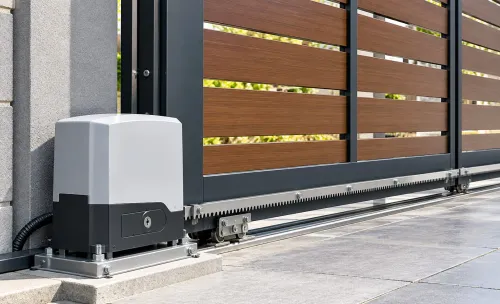
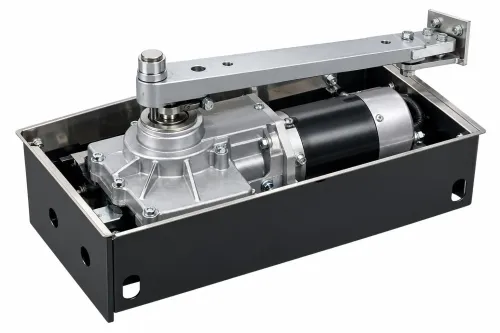
3. Install the carriage rollers, guide posts, gate leaf, operator, control cabinet and manual-release hardware. Set travel limits and leave access for maintenance.
4. Connect photocells, safety edges, warning lights, emergency stop, loop detectors and access control. Guard pinch and shear points, and verify wind loading separately from the motor’s weight rating.
5. At handover, record opening and closing time, smooth travel, limits, noise and current draw through repeated cycles.
6. Test obstruction detection, reversal, photocell interruption from both directions, emergency release, power failure, restart after power restoration and access-control commands. A photocell alone is insufficient: misalignment or a person already inside the closing zone can defeat it.
7. Give the buyer signed test results, drawings, settings, manuals and maintenance intervals.
Check a Raipur supplier’s delivery and after-sales scope
Ask a motorized cantilever gate supplier for Raipur to put its local service boundary in writing. Confirm that the quotation includes a site survey, delivery to your industrial entrance, installation, commissioning and after-sales visits within your operating area—not only dispatch of the gate and motor.
- Survey date, measured site conditions and a drawing showing the carriage foundation, guide-post foundation, anchor bolts, conduits, drainage and finished road levels.
- Delivery date tied to civil readiness, with responsibility stated for checking the concrete, side-run, road slope and cable routes before dispatch.
- Installation area covered, including Raipur industrial sites outside the supplier’s immediate city service zone.
- Commissioning scope: travel-time adjustment, limit-setting, photocell alignment, emergency-stop testing, manual release demonstration and access-control integration.
- Response time for a breakdown, inspection charges, labour charges, spare-parts availability and the contact method for an after-hours vehicle-exit failure.
- Warranty coverage for the operator, carriage bearings, control panel, photocells, loops, remotes, cables and paint finish.
The quotation should address Raipur dust, monsoon water, drainage, lightning and voltage variation. Ask where the control cabinet, junction boxes and buried cable joints will sit, and request their individual protection ratings; the motor’s IP rating does not protect every accessory.
A cantilever sliding gate supplier should also state the wind-load basis for a solid or closely infilled leaf, not just the motor’s weight rating. Nagpur Automation (08048400505) is worth asking for this installation-and-response schedule when comparing an industrial cantilever gate in Raipur with competing bids.
Related products
 | We are one of the leading manufacturers and suppliers of a wide range of Industrial Main Gates. View product → |
 | We are instrumental in offering a broad range of Industrial Gates to the clients. View product → |
Frequently asked questions
How does a cantilever gate keep the driveway clear for trucks?
Its leaf hangs from a bottom guide beam and moves on foundation-mounted roller carriages, so no wheel or road track crosses the driveway. A counterbalanced tail extends behind the opening and needs clear space.
What should you measure at a Raipur industrial entrance?
Measure the clear opening, available tail space, ground levels, foundation area, vehicle turning radius and the location of power and control equipment before choosing the gate.
How do cantilever, tracked, telescopic and swing gates differ?
Cantilever gates keep the roadway free but need tail space and substantial foundations. Tracked gates need a clean, level road track. Telescopic gates reduce tail space, while swing gates need clear arcs inside or outside the entrance.
What should a supplier include in installation and acceptance tests?
Specify the motor, roller carriages, guide beam, control panel, safety devices, manual release and installation sequence. Test full travel, limit positions, obstruction response, emergency stop, sensor operation and manual opening before handover.
How can you check a Raipur supplier’s delivery and after-sales scope?
Ask for the fabrication and delivery timeline, foundation requirements, commissioning responsibility, warranty terms, spare-parts availability, response process and written handover test results.
Related products
 | We are instrumental in offering a broad range of Automatic Industrial Gates to the clients. View product → |
 | Motorized Telescopic Gate Automatic Telescopic Sliding Gate With the support of our professionals, we are involved in offering best quality of Automatic Telescopic Sliding Gate. View product → |
 | We are offering a wide range of Swing Gate Automation. an aesthetic match for any architectural style. View product → |
 | We are engaged in offering Mild Steel Industrial Gates. These MS Industrial Gates are designed and fabricated using quality tested raw materials... View product → |
Keywords