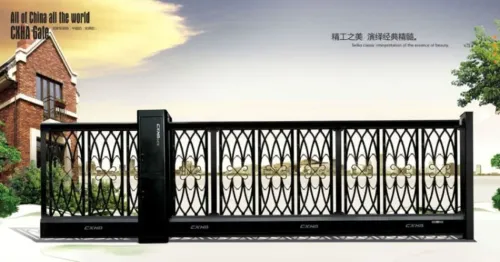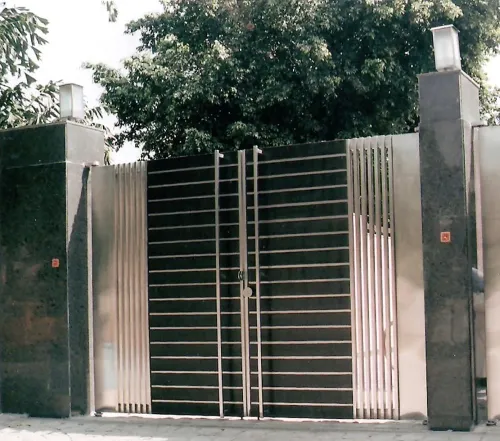
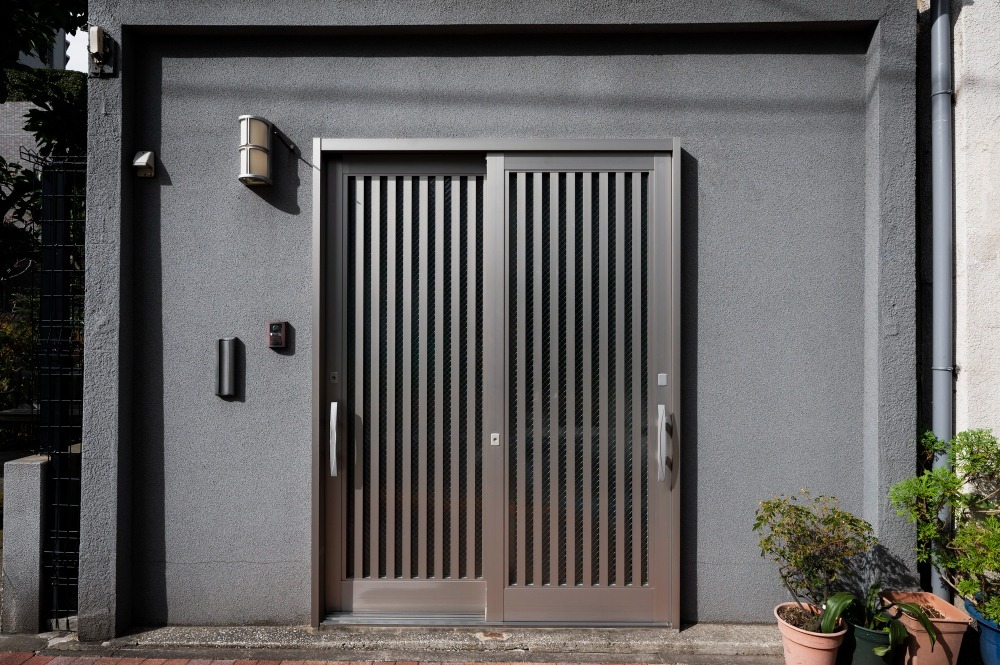
Large entrance openings can create a difficult design problem when there is not enough sideways space for a conventional sliding gate. A Motorized Telescopic Gate addresses this challenge by dividing the gate into multiple moving sections that overlap or stack as the entrance opens.
This makes telescopic systems particularly interesting for selected commercial, industrial, institutional, and premium residential properties in Nagpur, Maharashtra.
Why conventional sliding gates need more space
A standard single-panel sliding gate normally requires sufficient clear space beside the entrance to accommodate most or all of the gate leaf when opened.
Consider a wide industrial entrance. If the boundary immediately beside the opening contains a building, utility area, neighbouring property, or another obstruction, providing the required run-back distance may be difficult.
A telescopic configuration can reduce the amount of lateral storage space required.
How telescopic gates work
Instead of one long gate leaf, the entrance uses two or more coordinated panels.
During opening, these sections move in sequence and stack into a more compact area. The automation mechanism coordinates their movement so that the entrance can open without requiring the same run-back distance as a conventional single-leaf sliding arrangement.
The exact mechanism depends on the gate design and automation system.
Where can this configuration be useful?
A telescopic system may be evaluated for:
- Factories with wide vehicle entrances
- Warehouses and logistics facilities
- Commercial compounds
- Institutional campuses
- Large residential properties
- Sites with restricted boundary space
However, limited space alone does not automatically make a telescopic gate the right choice.
What should be checked first?
The entrance width and available run-back space should be measured accurately.
The installation also requires careful consideration of gate weight, panel design, mechanical coordination, motor capacity, track conditions, operating frequency, and safety equipment.
Because the system has multiple moving sections, correct alignment is especially important.
Traffic patterns should also be considered. A gate used occasionally at a private property presents a different operating requirement from an industrial entrance handling regular trucks, employees, and deliveries.
Is it worth considering over a standard gate?
The main reason to evaluate a telescopic design is space efficiency at wider openings. If a conventional sliding gate fits comfortably and satisfies operational requirements, additional mechanical complexity may not be necessary.
Where boundary limitations make conventional sliding difficult, however, telescopic movement can provide another practical design option.
Nagpur Automation works with entrance automation requirements in Nagpur and can assess available space, gate dimensions, operating cycles, and access-control needs before a system is selected.
A Motorized Telescopic Gate is therefore best viewed as a site-specific solution. Its value becomes clearer when a property needs a wide controlled entrance but cannot provide the lateral space normally required for a long single-panel sliding gate.
Keywords